Fibreoptic Intubation
Technique to secure a a (relatively) non-emergent definitive airway in a patient who has expected difficult laryngoscopy. May be:
- Nasal
- Better tolerated
Avoids gag reflex; though this can be overcome with good topicalisation. - Risk of bleeding
Relatively contraindicated in the acute setting or if presence of airway compromise.
- Better tolerated
- Oral
- Require better topicalisation
- Essentially requires an adjunct to be effective
Ovassapian or Berman.
Indications
- Difficult intubation
- Known
- Suspected
- Rescue
- Difficult ventilation
- Facemask
- LMA
- Cervical spine instability
Contraindications
- Absolute
- Lack of skill, assistance, or equipment
- Near-total upper airway obstruction
- Patient refusal
For AFOI. - Uncooperative patient
For AFOI.
- Relative contraindications
- Inability to tolerate apnoea
- Contaminated airway
Blood or soiling may:- Limit efficacy of topicalisation
- Reduce visualisation of normal structures
- Cover the camera lens
Equipment
Key equipment:
- Bronchoscope
Sized appropriately. An ‘adult’ bronchoscope will fit inside a 6.0 ETT - ETT
- Sizing
- Big enough to:
- Allow adequate ventilation
- Fit the scope
- Small enough to:
- Fit through the nose (if nasal)
- Minimise the gap between tube and scope
- Big enough to:
- PVC tubes
- Appropriate for ICU/ intubation
- Not appropriate for nasal intubation
- Reinforced
- Easier to negotiate
- Not recommended for long-term use
- May not have a Murphy eye
- iLMA ETT
- Soft tip
- Snug tip fits scope well
- Flexible allows it to negotiate corners
- Length may be an issue
- Parker Flex ETT
- Flexes and curves past protruding airway structures, smoothing passage
- Not as good as iLMA for railroading
- Nasal RAE
- Long enough even if using small tubes
- Pre-formed curve makes it harder to manipulate during railroading
- Sizing
- Oral intubation aids
- Ovassapian
Keeps scope in midline.- Single size
- ↑ failure rate compared to Berman
- Berman
Keeps scope in midline and flange allows adjustment of view.- Multiple sizes
- Ovassapian
Generally, use a Parker Flex-Tip or Fast-track ETT. If planning nasal intubation, use a 6.0 for females and a 6.5 for males.
Technique
Supplemental oxygen should always be provided.
Sedation is not a substitute for topicalisation, but sedation is not required if good topicalisation is performed. (Still nice though).
Preparation
- Positioning
Two options- Patient supine with operator in normal intubating position
- Patient sitting upright and facing the operator
- Drugs and Equipment
- Glycopyrrolate
- Lignocaine
- Have additional syringes to topicalise cords under vision
- 2× 10mL syringes containing 2mL 2% lignocaine and 8mL air
- Have additional syringes to topicalise cords under vision
- Oxygenate
- High flow nasal prongs
If oral FOI. - Nasal cannula
Through opposite nostril if nasal FOI. - Through suction port of bronchoscope
1-2L/min assists oxygenation and clears blood and secretions from view. - Through a paediatric ETT in opposite nostril
Allows gas monitoring.
- High flow nasal prongs
Silicone or lignocaine spray are excellent lubricants for the bronchoscope and ETT.
Sedation
- Aim for conscious sedation. Consider:
- Midazolam and a small dose of fentanyl
Familiar and reversible. - Remifentanil TCI (Minto) Ce 1-3ng/mL
- Ketamine
Minimises respiratory depression, but oral secretions may be problematic.
- Midazolam and a small dose of fentanyl
- Risk of oversedation is high
- Second anaesthetist for sedation is desirable
- Use sedation cautiously and minimalistically
- Propofol is not recommended
- Avoid in the critically ill
Topicalisation
Many different topicalisation recipes exist; many are equally good. All require good explanation. Set expectations.
- Antisialagogue (Glycopyrrolate 200-400μg)
- Aids visualisation and improves local anaesthetic efficacy
- Aim to give >5 minutes before topicalisation
- For nasal intubation:
- Vasoconstriction
5× cophenylcaine sprays to nose - Topicalise:
- Using EZ atomiser:
- O2 at 10L/min
- Give 1/3rd of lignocaine dose to the nostril to be intubated
- Using serial dilation of nostril:
- Use a selection of NPAs well lubricated with 2% viscous lignocaine gel
- Dilate every 3-5 minutes in 0.5 size increments up to intended tube size
- Using EZ atomiser:
- Topicalise airway as below
- Vasoconstriction
- For oral intubation:
- Using MAD:
- Spray with 10% lignocaine via MAD over 5 minutes
Up to 9mg/kg. Spray:- Oropharynx
- Tonsillar pillars
- Base of tongue
- Have 2% lignocaine available for top-up spray-as-you-go
- Spray with 10% lignocaine via MAD over 5 minutes
- Using EZ atomiser:
- O2 at 10L/min
- Spray tonsillar pillars, posterior tongue, posterior pharynx
- Turn nozzle down, and spray epiglottis and cords
- Using high-flow nasal oxygen:
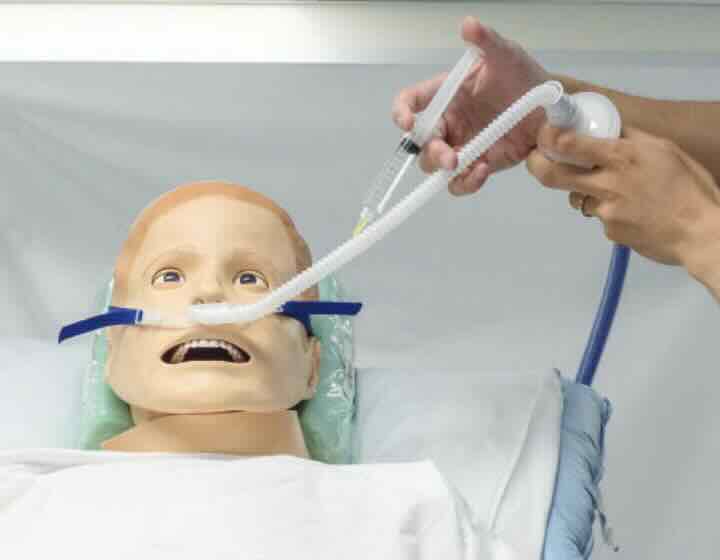
- Inject 10-15mL of 2% lignocaine via a 27G or 30G needle into the distal portion of the oxygen tubing, synchronised with respiration
- Using MAD:
2% lignocaine is as effective as higher concentrations of lignocaine, provided the dose is correct.
| LBW (kg) | Maximum total dose | Volume for atomiser | Volume available for top up |
|---|---|---|---|
| 40 | 230 | 10 | 1.5 |
| 45 | 275 | 10 | 3.75 |
| 50 | 320 | 12 | 4 |
| 55 | 365 | 13 | 5.25 |
| 60 | 410 | 14 | 6.5 |
| 65 | 455 | 15 | 7.75 |
| 70 | 500 | 15 | 10 |
| 75 | 545 | 15 | 12.25 |
| 80 | 590 | 15 | 14.75 |
| 85 | 635 | 15 | 16.75 |
| 90 | 680 | 15 | 19 |
| 95 | 725 | 15 | 21.25 |
| 100 | 770 | 15 | 23.5 |
Nasal Intubation
- Pass scope through nose
- Identify:
- Inferior turbinate
- Middle turbinate
- Nasal septum
- Patient may swallow at this point
This will close the nasopharynx; sniffing will re-open. - Pass infero-medially to the inferior turbinate
If difficult, consider using an NPA to traverse nares:
- Cut NPA along one side so it can be split open
- Insert NPA
- Pass bronchoscope through NPA
- Remove NPA over bronchoscope
Oral Intubation
In the asleep patient, jaw thrust and pulling the tongue forward (have assistant use gauze-wrapped forceps) significantly increases space in the back of the oropharynx.
- Protect the scope
- Bite block
- Berman Airway
- Place ETT through teeth
- Identify the uvula and continue into the oropharynx
- (Remember to spray-as-you-go with 2% lignocaine from here)
- Identify the larynx
Slight anterior flexion smooths passage through. - Identify the carina
Posterior flexion is required to negotiate the secondary curve of the trachea. - Advance tube over bronchoscope
- Confirm position with two-point check
Capnography and visualisation. - Induce anaesthesia
Emergency Fibreoptic
If time-critical but laryngoscopy not feasible:
- Cophenylcaine
- Lubricated nasal tube into nasopharynx
- Fibreoptic through nasal tube and drop into cords
References
- Ahmad I, El‐Boghdadly K, Bhagrath R, et al. Difficult Airway Society guidelines for awake tracheal intubation (ATI) in adults. Anaesthesia. n/a(n/a). doi:10.1111/anae.14904
- Zhong G, Downey RG. Airway topicalisation via direct injection of local anaesthetic into the lumen of high flow oxygenation devices. Anaesth Intensive Care. 2020 Sep;48(5):409–10. doi:10.1177/0310057X20946049
- St Vincents FOI training manual