Closure of Patent Foramen Ovale and Atrial Septal Defects
Airway: ETT
Access: 18G
Pain: Minimal
Position: Supine
Time:
Blood loss:
Special:
- TOE required
- Low volume, high respiratory rate
Percutaneous closure of atrial septal defects can be performed for:
- Patent foramen ovale
- Secundum ASD
Primum ASD are not amenable to percutaneous closure due to the lack of safe landing zone for an occlusion device against the AV margin.
Surgical Stages
- Groin access
- Transeptal puncture
Guidewire passed through the fossa ovalis into the LA.- Needle “tenting” (if passing through septal tissue) is assessed under echocardiography
- First in the superior-inferior (bicaval) position
- Second in the aortic short axis position (for anterior-posterior position)
- The four chamber can be used to determine height above the MV annulus
- Needle “tenting” (if passing through septal tissue) is assessed under echocardiography
- Defect sized
- Sizing balloon passed over guidewire into defect and inflated
- Septum indents the balloon, appearing as a ‘waist’ on fluoroscopy and echocardiography
- Measurement of the waist in orthogonal planes sizes the closure device
- LA disc deployed and positioned
- RA disc deployed and positioned
- Occlusion assessed
- Deployment mechanism removed
Optimal “tenting” position depends on the procedure:
|
Superior–inferior axis (bicaval view) | Anterior–posterior axis (AV short-axis view) |
| PFO closure | Superior | Anterior |
| LAA occlusion | Inferior | Posterior |
| Ablation procedures | Middle | Middle |
| Paravalvular leak closure | Mid to superior | Mid to posterior |
| MV valvotomy | Mid to superior | Mid to posterior |
| MV repair | Mid to superior Ideally 4-5cm above grasping zone. |
Mid to posterior |
Preoperative
Assessment:
- Cryptogenic stroke
- Right heart volume overload
- Right heart dysfunction
- Pulmonary hypertension
- Clinical right heart failure
- Preoperative echocardiography
- Presence of atrial septal aneurysm
- Chiari network
- Atrial thrombi
Contraindication until cleared.
Consultation:
Optimisation:
Premedication:
Explain/Consent:
Intraoperative
Preparation:
Induction:
Maintenance:
Echocardiography:
- 2D imaging typically provides higher temporal and spatial resolution of the thin and mobile septum
- 3D imaging may be helpful for defining the shape of the defect and relationship to surrounding structures, and for confirming the device has captured the margins
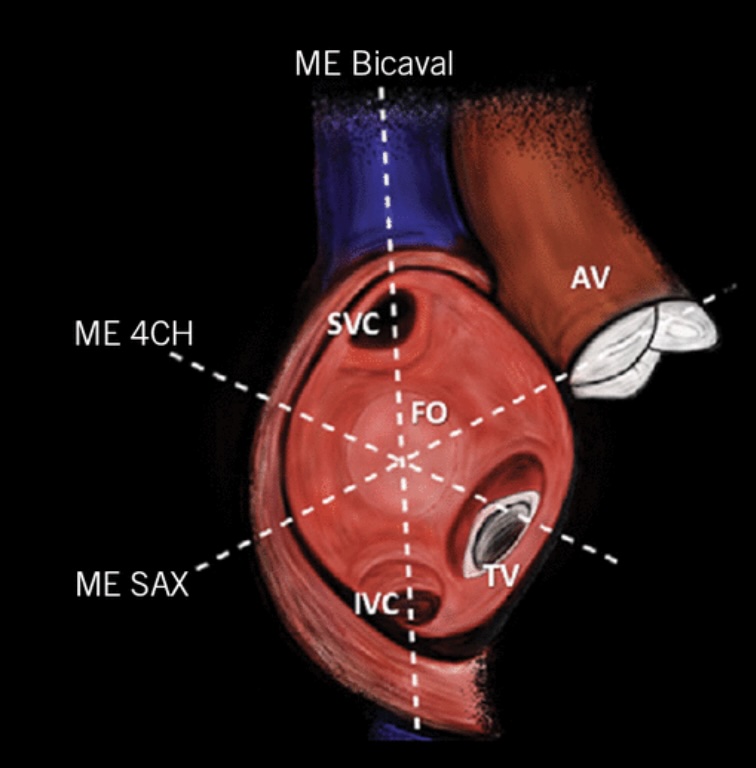
- Exclude atrial thrombi
- Conduct critical measurements
Defect should be <35mm diameter, with margins ideally >5mm.- AV Short Axis
For anterior-posterior position.- Posterior margin
- Anterior margin
At aortic valve. Commonly <5mm.
- Bicaval
For superior-inferior position.- Inferior margin
At IVC. - Superior margin
At SVC.
- Inferior margin
- MO 4-chamber
For position in relation to the MV annulus.
- AV Short Axis
- Closure device sizing
- LA position assessment
2D and 3D. - RA position assessment
- Closure device position
- Small amount of residual flow is common, and may persistent until endothelialised
- Assess stability
- Assess interference with:
- SVC
- Aorta
- PV
- AV
- Rule out pericardial collection
Emergence:
Postoperative
Disposition:
Referrals/Review:
Analgesia:
Fluids:
Thromboprophylaxis:
Specific: